Enterprise SaaS Portfolio Modernization
SAAS
2026
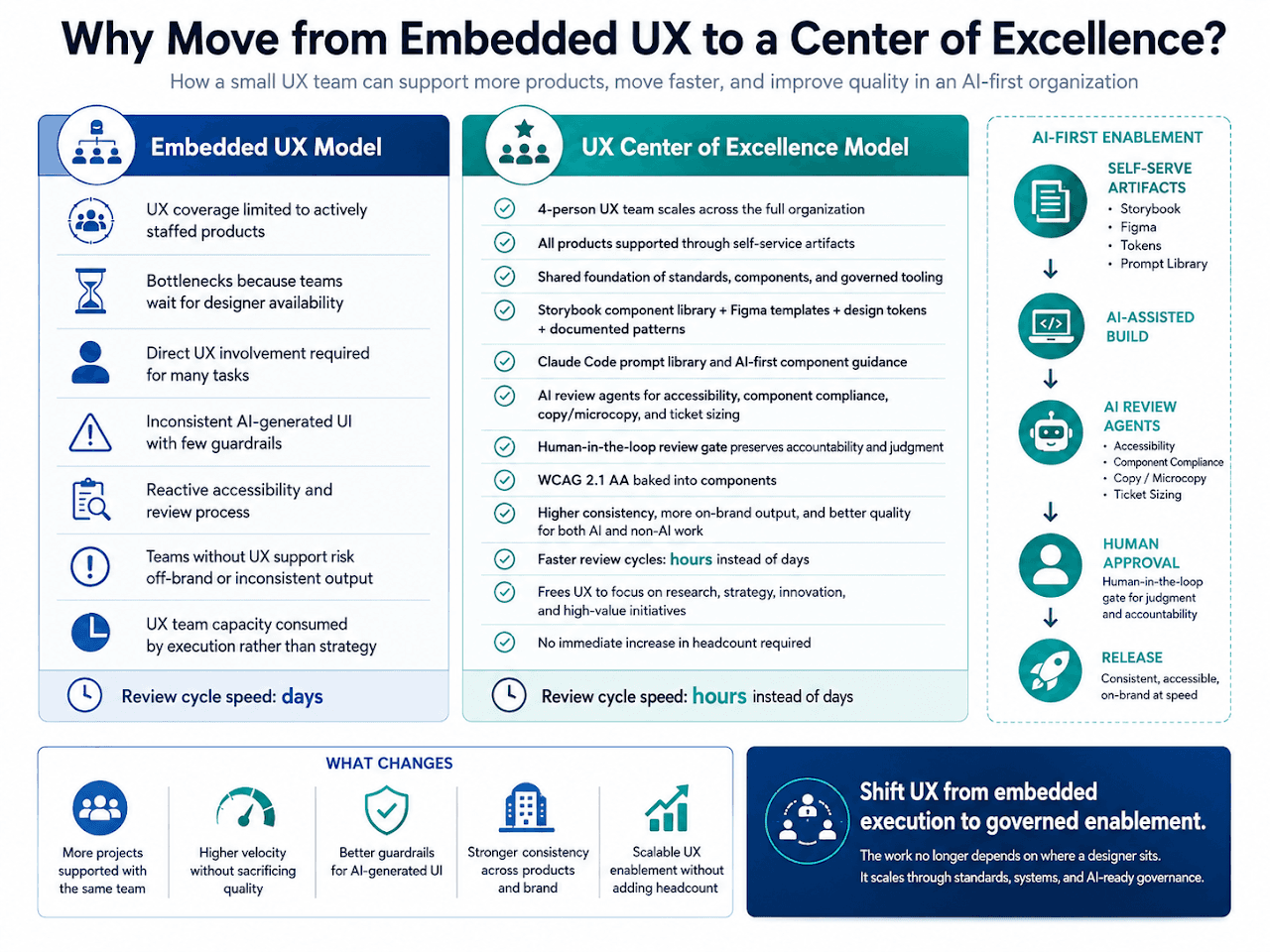
Operative Media Enterprise SaaS Portfolio Modernization VP, Product Design Transforming a fragmented five-product enterprise SaaS portfolio into a more scalable design operating model—connecting organization, design systems, AI-enabled workflows, accessibility, and customer evidence to measurable product and business outcomes. Enterprise SaaS · Product Design Leadership · Design Systems · AI · Accessibility The Challenge Five product lines had evolved across different technology stacks, workflows, and UI patterns. Design was largely embedded within individual delivery teams, making portfolio-wide consistency, reuse, governance, and measurement difficult. After a 20% workforce reduction, a smaller organization also needed to support a growing roadmap without sacrificing quality or delivery momentum. The Leadership Question How could Design increase its impact without simply adding more people or process? The Transformation I focused on four connected sources of leverage. 01 — Organization Embedded Support → Design Center of Excellence Evolved Product Design toward a Center of Excellence focused on reusable standards, governance, accessibility, design-system stewardship, executive review, and team enablement. The goal was to make expertise easier for Product and Engineering to access without routing every recurring decision through Design. Principle: Enablement over gatekeeping. 02 — Infrastructure Fragmented Patterns → Shared Product Foundations Unified fragmented UI patterns and strengthened an enterprise design system connecting Figma, Storybook, reusable components, accessibility guidance, documentation, and Product/Engineering workflows. The objective was not a larger component library. It was a more scalable foundation for consistency, reuse, quality, and design-to-engineering throughput. 03 — Intelligence Recurring Manual Work → AI-Enabled Leverage Introduced AI-supported workflows across research synthesis, UX exploration, prototyping, content, design-system documentation, accessibility review, and recurring UI validation. AI was used to reduce repetitive effort and expand coverage—not replace design judgment. Designers remained accountable for strategy, new interaction patterns, accessibility edge cases, trust-sensitive decisions, and ambiguous or high-risk experiences. Principle: Systems over heroics. AI for repetition. People for judgment. 04 — Evidence Design Opinion → Product Evidence Embedded research, NPS, CSAT, behavioral analytics, accessibility, and customer signals more directly into governance, prioritization, and executive planning. This strengthened Design's role in decisions involving customer experience, product quality, delivery efficiency, retention, accessibility, and platform health. Impact at a Glance Across the broader cross-functional transformation: 23% Reduction in platform development costs the work helped enable 18% Increase in release velocity 20–30% Improvement in design and engineering cycle time Record-high Client retention supported The transformation also improved cross-product consistency, design-to-engineering throughput, accessibility, reusable infrastructure, and portfolio governance. Product work received IBC and NAB recognition.